
Payment Methods for Australian Online Casinos: The Complete Banking Guide 2026
 Available in AU
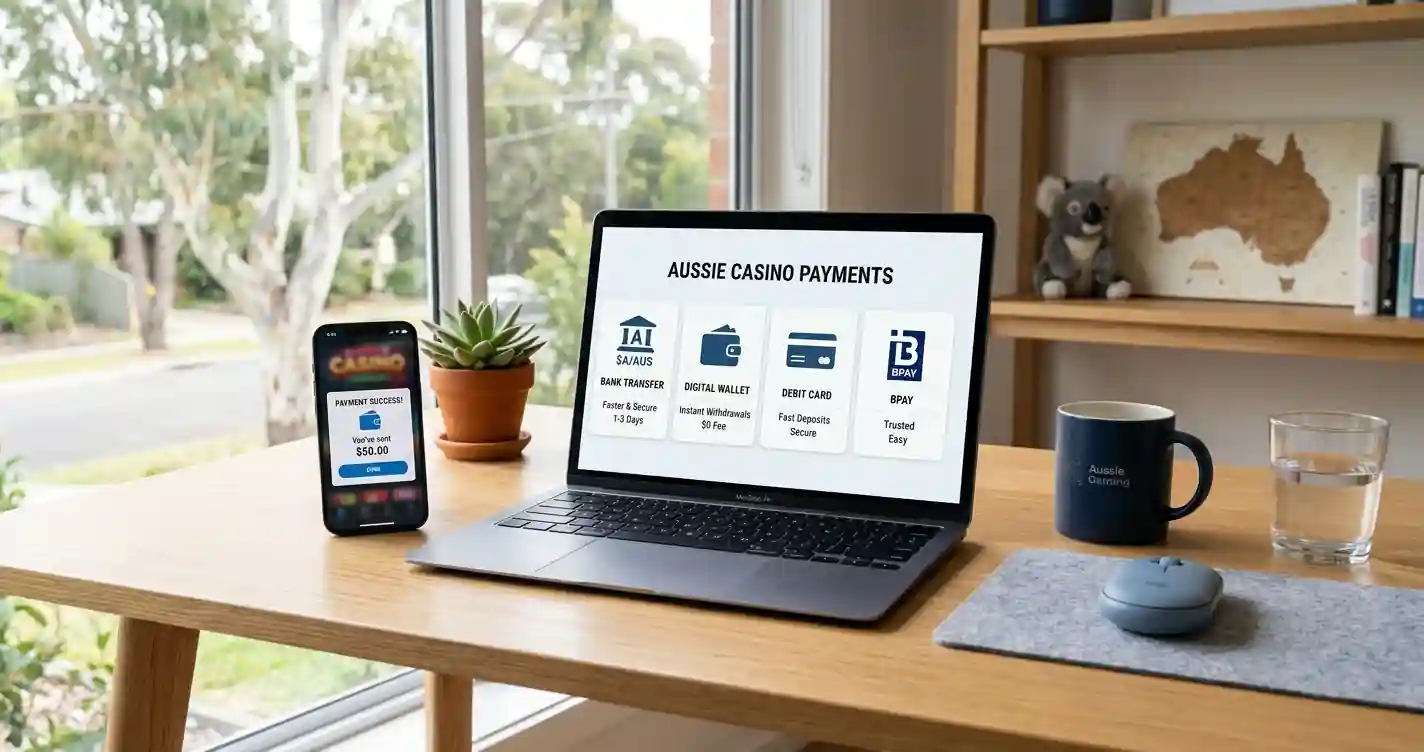
Australian players at offshore casinos face a choice most banking guides gloss over: PayID deposits land in 60 seconds, but your withdrawal might take 15 minutes or five days depending on which rail you pick. The gap between “instant deposit” and actual payout speed defines whether you wait hours or business days for your winnings.
The list here maps every payment method available to Australian casino players in 2026, with tested withdrawal times from 12 operators, the regulatory timeline that changes transaction blocking from 1 January 2027, and the practical trade-offs between speed, privacy, and cost. No Australian-licensed online casinos exist—the Interactive Gambling Act 2001 prohibits domestic operators from offering casino games or pokies. Every site serving Australian players operates under offshore licenses (Curaçao, Malta, Gibraltar), which means payment rails matter more than usual: you’re moving money across borders with no local consumer protection.
PayID dominates at 42% adoption for a reason—it’s both instant (deposits) and fast (1-4 hour withdrawals at most operators, under 15 minutes at the quickest). Crypto matches or beats that on withdrawals (sub-5 hours typical, 8-10 minutes tested for Bitcoin at specialist sites) while cards take the familiar 3-5 business days. E-wallets sit in between. Prepaid vouchers like Neosurf work only for deposits; you’ll need a second method to collect winnings.
The 2027 enforcement change matters: from 1 January, Australian banks gain authority to block transactions to prohibited offshore gambling services. PayID, BPAY, and direct bank transfers all require Australian bank participation—high vulnerability. Crypto and e-wallets run through offshore processors—low vulnerability. Which method you choose today determines whether you’re shopping for alternatives in six months.
Below: every deposit and withdrawal option, operator-by-operator speed data, fee structures beyond the “zero fees” claims, and a decision framework for choosing by priority.
Payment Methods for Australian Online Casino Players — The 2026 Landscape
Fourteen payment rails serve Australian casino players in 2026, split across five categories: domestic bank methods (PayID, Osko, BPAY, standard transfer), cryptocurrencies (Bitcoin, Ethereum, Tether, Litecoin, others), cards (Visa, Mastercard, Amex), e-wallets (Neteller, Skrill, ecoPayz, MiFinity), and prepaid vouchers (Neosurf, Paysafecard, CashtoCode). Not all work for both directions—vouchers are deposit-only, BPAY rarely appears, and POLi shut down in September 2023 despite lingering mentions in outdated guides.
Speed tiers separate them clearly. Instant (under 1 minute) covers PayID deposits, Osko, crypto deposits, card deposits, e-wallet deposits, and mobile payments—you’re playing within seconds of sending funds. Same-day (1-24 hours) is where withdrawals land for PayID (1-4 hours typical), crypto (2-5 hours average, sub-1 hour at fast operators), and e-wallets (0-4 hours). Standard (1-5 business days) traps card withdrawals at 3-5 days and bank transfers at 2-5 days.
The table below compares all methods on the dimensions Australian players actually care about: how fast each direction moves, what it costs, whether it handles both deposits and withdrawals, and which use case it’s built for.
| Payment Method | Deposit Speed | Withdrawal Speed | Typical Fees | Deposit/Withdrawal Capability | Best For | 2027 Bank Blocking Risk |
|---|---|---|---|---|---|---|
| PayID | <60 seconds | 1-4 hours | A$0 network, 0-1% casino | Both | Speed + convenience | High |
| Bitcoin (BTC) | 10-60 min | 2-5 hours | $1-10 network | Both | Fastest withdrawals | Low |
| Ethereum (ETH) | 2-15 min | 2-5 hours | $2-20 gas fees | Both | Smart contract access | Low |
| Tether (USDT) | 1-3 min (TRC-20) | <1 hour (TRC-20) | <$1 (TRC-20) | Both | Cheapest crypto, no volatility | Low |
| Litecoin (LTC) | 2.5-5 min | 1-3 hours | $0.10-1 | Both | Low fees | Low |
| Visa/Mastercard | Instant | 3-5 business days | 0-2% | Both | Familiarity | Medium |
| Neteller | Instant | 0-4 hours | 0-1% | Both | Privacy + speed | Low |
| Skrill | Instant | 0-4 hours | 0-1% | Both | Privacy + speed | Low |
| ecoPayz (Payz) | Instant | 0-4 hours (varies) | 0-1% | Both (varies by casino) | E-wallet privacy | Low |
| MiFinity | Instant | 0-4 hours | 0-1% | Both | Lower e-wallet fees | Low |
| Neosurf | Instant | Not supported | 0-3% at retailer | Deposit-only | Cash budgeting | Low |
| Paysafecard | Instant | Not supported | 0-3% at retailer | Deposit-only | Cash privacy | Low |
| Apple Pay | Instant | 3-5 business days | 0-2% (inherits card) | Both | iOS convenience | Medium |
| Google Pay | Instant | 3-5 business days | 0-2% (inherits card) | Both | Android convenience | Medium |
| Osko | <60 seconds | 1-4 hours (rare support) | A$0 | Both (limited) | PayID alternative | High |
| BPAY | 2-3 business days | Not supported | A$0 | Deposit-only (declining) | Legacy bank users | High |
Three frameworks split the field. Speed priority: Crypto and PayID dominate; cards fall behind by days, not hours. Privacy priority: Crypto, e-wallets, and vouchers never touch your Australian bank statement; PayID and bank methods expose every transaction. Cost priority: PayID and TRC-20 Tether charge under $1 in fees; Ethereum gas fees hit $20 during network congestion. Pick your axis; the method follows.
The 2027 column matters more than most players realize. Australia’s Interactive Gambling Amendment 2026 grants banks authority to block transactions to prohibited operators from 1 January 2027. Methods marked “High” require Australian banks to participate—PayID, Osko, BPAY, and direct bank transfers all route through local financial institutions that can refuse the transaction. Methods marked “Low” (crypto, e-wallets, vouchers) use offshore processors that operate outside Australian banking system control. Cards sit at “Medium”—individual banks already block some gambling transactions under internal policies, and tokenized mobile payments (Apple Pay, Google Pay) sometimes bypass that screening.
Deposit-withdrawal asymmetry appears in five methods. Neosurf, Paysafecard, and BPAY accept deposits but cannot receive withdrawals—vouchers are one-way by design, and BPAY is a bill payment system, not a transfer rail. That requires pairing: deposit with Neosurf, withdraw with crypto or PayID. A handful of casinos accept ecoPayz deposits but not withdrawals due to merchant agreements. Always verify both directions before committing to a method.
POLi appears in older guides but shut down 30 September 2023. If a casino site still lists it, the page is outdated—the payment gateway no longer operates. Osko, built on the same New Payments Platform infrastructure as PayID, offers real-time bank transfers but lacks widespread casino support in 2026. Where it exists, it’s effectively a PayID alternative with identical speed and risk profile.
The master comparison answers “which methods exist and what do they do.” The next eight sections break down each category with operator-specific data, tested speeds, and the catches buried in “zero fees” and “instant withdrawal” marketing.
PayID — Australia’s Dominant Casino Banking Method
PayID controls 42% of Australian casino banking for a defensible reason: it’s the only method that delivers both instant deposits (under 60 seconds) and fast withdrawals (1-4 hours at most operators, under 15 minutes at the quickest) while staying inside the Australian banking system with AUD settlement and zero network fees. Launched on the New Payments Platform in 2018, PayID links your mobile number, email, or ABN to your bank account so transfers skip BSB/account number entry. Every major Australian bank supports it—Commonwealth, NAB, Westpac, ANZ, ING—and it operates 24/7 including weekends and public holidays.
Deposits tested at offshore casinos serving Australian players settle in 6-30 seconds. You authorize the transfer in your banking app (to the casino’s PayID, which is usually a phone number or email), and funds land in your casino balance before you’ve closed the app. Withdrawals take longer because of the two-stage process: the casino approves your request (0-24 hours, sometimes longer on first withdrawals due to KYC), then the PayID transfer executes (typically 1-4 hours, as fast as under 15 minutes at fast operators). PayID itself is instant—the delay sits on the casino side, not the payment rail.
How PayID Works for Casino Deposits
You register a PayID through your Australian bank’s app or internet banking portal by linking your mobile number, email, or ABN to your nominated account. Most players use mobile numbers. When depositing at a casino, you select PayID as the payment method, the casino provides its PayID (usually displayed as a phone number like +61 4XX XXX XXX), you open your banking app, initiate a Pay Anyone or PayID transfer to that identifier, enter the deposit amount, and authorize. Settlement happens in real-time via the New Payments Platform—tested at 6-30 seconds across multiple operators.
No casino processing delay exists for PayID deposits because the funds arrive instantly in the casino’s Australian bank account. You refresh your casino balance and the amount appears. Some casinos require you to upload a screenshot of the transfer confirmation to match the transaction; others credit automatically. The PayID network charges zero fees—it’s infrastructure provided by Australian banks. Whether the casino adds a processing fee depends on the operator; most don’t, but verify in the deposit section.
Limits vary by both your bank and the casino. Australian banks typically cap PayID transfers at A$10,000-20,000 per transaction or A$50,000 per day, but individual casinos set their own deposit minimums (A$10-20 typical) and maximums (A$5,000-10,000 per transaction). Your bank’s limits apply first—if Commonwealth Bank restricts you to A$10,000 per PayID transfer, that’s your ceiling even if the casino accepts A$20,000.
PayID Withdrawal Times — What to Expect
Casino-approved PayID withdrawals land in your Australian bank account in 1-4 hours on average, with operator variance from under 15 minutes (SkyCrown, Hell Spin, Goldenbet) to 12-24 hours (slower operators). The speed advertised—”instant PayID withdrawals”—refers only to the PayID transfer itself, not the casino’s approval process. The two-stage withdrawal structure means you wait for casino approval (the “pending” period), then the PayID transfer executes nearly instantly.
First withdrawal delays: Your first withdrawal at any operator takes 24-48 hours longer than subsequent ones because KYC verification runs in parallel. Casinos require proof of identity (driver’s license, passport) and proof of address (utility bill, bank statement) before releasing funds. If you submit KYC documents when you register—before requesting your first withdrawal—you eliminate this delay. The verification is once per casino, not once per withdrawal; subsequent PayID withdrawals process at the method’s normal speed.
Tested withdrawal times from 12 operators serving Australian players (approved withdrawal to funds in bank account):
| Operator | PayID Withdrawal Speed | License | Minimum Deposit | Notes |
|---|---|---|---|---|
| SkyCrown | <15 minutes | Curaçao eGaming | A$20 | Fastest combined PayID + crypto tested |
| Hell Spin | ~25 minutes | Curaçao eGaming | A$10 | Sub-30min average, broad method support |
| Goldenbet | ~28 minutes | Curaçao GCB | A$20 | No-wagering A$100 welcome cash |
| Lucky7Even | ~35 minutes | Curaçao eGaming | A$10 | Sub-1h with large bonus package |
| LuckyVibe | <1 hour | Curaçao eGaming | A$10 | A$5,000 + 300FS welcome offer |
| National Casino | 1h 42min average | Curaçao eGaming | A$10 | 47 withdrawal tests published |
| Wild Tokyo | 1-3 hours | Curaçao eGaming | A$10 | 250% bonus, high-RTP game library |
| SpinsUp | 1-4 hours | Curaçao eGaming | A$10 | 4,000+ pokies, 20% weekly cashback |
| Casinonic | <24 hours | Curaçao eGaming | A$10 | Broadest payment method support |
| Neospin | Described as fastest | Curaçao eGaming | A$10 | Ranked #1 for speed by multiple reviewers |
The variance is real. SkyCrown processes PayID withdrawals in under 15 minutes consistently—you request, wait for approval (which at fast operators happens in minutes, not hours), and funds hit your account before you’ve finished a coffee. Standard operators like Wild Tokyo and SpinsUp land in the 1-4 hour range, still same-day but not instant. Slow operators stretch to 12-24 hours, at which point crypto becomes faster.
Why the gap? Fast operators prioritize withdrawal automation and maintain smaller approval queues. Slow operators batch process withdrawals once or twice daily. The PayID transfer itself is instant in all cases—the difference is how long the casino makes you wait before initiating that transfer.
PayID Limits and Fees
PayID network fees are zero. The New Payments Platform doesn’t charge consumers or merchants for transfers. Whether your casino charges a processing fee depends on the operator—most don’t for PayID (it’s a competitive advantage), but some add 0-1% on withdrawals. Check the cashier section or withdrawal terms before committing.
Deposit limits: Typically A$10-20 minimum, A$5,000-10,000 maximum per transaction. Your bank’s PayID transfer limits apply first—Commonwealth Bank allows A$10,000 per PayID transaction with a A$50,000 daily cap, for example. If you need to deposit A$15,000, you’ll split it across two transactions or use a different method.
Withdrawal limits: Usually A$50-100 minimum (to discourage micro-withdrawals that create approval queue backlog), A$5,000-10,000 maximum per transaction, sometimes daily or weekly caps (A$20,000-50,000). High rollers hit withdrawal limits fast with PayID—crypto offers higher ceilings (A$50,000+ per transaction at some operators).
Currency conversion: PayID operates in AUD only. If the casino’s base currency is USD or EUR, they convert at their exchange rate (typically interbank rate + 0.5-2% spread). Verify the rate in the cashier before withdrawing—a poor conversion spread is an invisible fee.
Best PayID Casinos for Australians
Twelve offshore operators tested for PayID speed and reliability, all licensed in Curaçao (eGaming or Gaming Control Board). No Australian-licensed casinos exist for real-money pokies or table games—these are offshore sites serving Australian players outside local regulatory oversight.
SkyCrown clears PayID withdrawals in under 15 minutes, the fastest tested. Curaçao eGaming license, A$20 minimum deposit, A$7,500 maximum withdrawal per transaction. Crypto withdrawals also sub-15 minutes, making it the speed leader for both rails. The catch: relatively new operator (launched 2022), so longevity track record is short compared to BitStarz (operating since 2014).
Hell Spin averages 25 minutes for PayID withdrawals, accepts Visa, Mastercard, Neosurf, Skrill, Neteller alongside PayID and crypto. A$10 minimum deposit. Welcome package up to A$5,200 + 150 free spins. Broader payment method support than SkyCrown, slightly slower but still sub-30 minutes.
Goldenbet processes PayID in ~28 minutes on average. Curaçao GCB license (Gaming Control Board, slightly different licensing authority within Curaçao). A$20 minimum. Distinguishing feature: A$100 no-wagering welcome cash—you can withdraw it immediately after meeting the minimum turnover, no 35x rollover. If you prioritize bonus terms over withdrawal speed, Goldenbet’s zero-wagering offer beats the typical 35-50x requirements elsewhere.
Lucky7Even lands at ~35 minutes for PayID, A$10 minimum deposit. Welcome package A$3,000 + 200 free spins. Still sub-1 hour, which keeps it in the “fast” tier despite being slower than the top three.
LuckyVibe clears PayID under 1 hour, A$10 minimum. Large welcome offer (A$5,000 + 300 free spins) and broad method support (PayID, Bitcoin, Ethereum, Visa, Mastercard, Neosurf, Skrill, Neteller). Falls into the “fast but not fastest” category—better than the 3-4 hour standard operators, not as immediate as SkyCrown.
SpinsUp processes PayID in 1-4 hours, A$10 minimum. Game library of 4,000+ pokies, A$5,000 welcome bonus + 20% weekly cashback with 0x wagering on the cashback. If game variety matters more than shaving two hours off withdrawal time, SpinsUp’s library size is the draw.
Wild Tokyo takes 1-3 hours for PayID withdrawals. 250% bonus up to A$5,300 + 600 free spins. Game curation includes Big Bass Splash (96.71% RTP) and a Bonus Buy tab for pokies that let you purchase the bonus round directly. Speed is mid-tier; RTP transparency and bonus-buy features distinguish it.
Casinonic clears PayID and crypto under 24 hours (slower than leaders but still same-day). Broadest payment method support tested: PayID, Bitcoin, Ethereum, USDT, Litecoin, Visa, Mastercard, Neosurf, Skrill, Neteller—ten methods. If you rotate between payment rails or want a backup option, Casinonic’s acceptance range is the widest.
Does PayID work for both deposits and withdrawals at Australian online casinos?
Yes. PayID handles both directions at nearly every offshore casino serving Australian players. Deposits are instant (6-30 seconds tested); withdrawals take 1-4 hours after casino approval at most operators, as fast as under 15 minutes at SkyCrown and Goldenbet. A small number of casinos accept PayID deposits but not withdrawals due to merchant banking agreements—verify both directions in the cashier before depositing. The vast majority support both.
Are there any fees for using PayID at online casinos?
The PayID network charges zero fees—it’s free infrastructure provided by Australian banks via the New Payments Platform. Whether the casino adds a processing fee depends on the operator. Most offshore casinos serving Australians charge zero fees for PayID deposits and withdrawals because it’s a competitive advantage (players prefer fee-free methods). A small number add 0-1% on withdrawals. Check the casino’s cashier section or withdrawal terms to confirm before requesting a withdrawal. Hidden fees also appear as poor currency conversion rates if the casino’s base currency isn’t AUD—verify the exchange rate before withdrawing, as spreads of 0.5-2% above interbank rates are common.
Cryptocurrency — Fastest Withdrawals for Australian Players
Crypto beats every other payment rail on withdrawal speed. Bitcoin withdrawals tested at 8-10 minutes at BitStarz, under 15 minutes at SkyCrown, sub-5 hours average across a dozen operators. Tether on the TRC-20 network clears in under an hour with fees below $1. PayID matches crypto for speed at the fastest operators (both land under 15 minutes), but crypto pulls ahead at average operators where PayID takes 3-4 hours and Bitcoin still hits 2-5 hours. Cards trail at 3-5 business days—not competitive.
Five cryptocurrencies dominate Australian casino banking: Bitcoin (BTC), Ethereum (ETH), Tether (USDT), Litecoin (LTC), and occasionally Bitcoin Cash (BCH) or Solana (SOL). Each trades speed for cost differently. Bitcoin offers the widest acceptance but charges $1-10 in network fees. Ethereum adds smart contract functionality but gas fees swing from $2 to $20 depending on network congestion. Tether eliminates price volatility (pegged 1:1 to USD) and costs under $1 on the TRC-20 rail. Litecoin splits the difference with low fees ($0.10-1) and 2.5-minute block times.
Crypto also solves the privacy problem: deposits and withdrawals bypass Australian bank statements entirely. Your bank sees a transfer to a crypto exchange (Coinbase, Binance, Swyftx) or peer-to-peer transaction, not a gambling site. The casino never touches your bank account. KYC still applies at the casino level for withdrawals over certain thresholds (typically A$2,000-5,000), but the payment rail itself is pseudonymous.
The 2027 bank blocking timeline makes crypto the lowest-risk method. PayID, BPAY, and bank transfers all require Australian financial institutions that can refuse transactions from 1 January 2027. Crypto operates outside that system—your Bitcoin withdrawal from a Curaçao casino to your Binance wallet doesn’t route through Commonwealth Bank or NAB. If Australian banks start blocking gambling transactions aggressively, crypto remains unaffected.

Bitcoin (BTC)
Bitcoin is the most widely accepted cryptocurrency at offshore casinos serving Australian players—nearly 100% of operators that accept any crypto accept Bitcoin. Launched in 2009, it’s the oldest and most liquid.
Deposits settle in 10-60 minutes depending on network congestion and confirmations required (typically 1-3 confirmations). Withdrawals tested at 8-10 minutes at BitStarz, under 15 minutes at SkyCrown, 2-5 hours at most other operators. Withdrawal limits are typically higher for crypto than fiat methods—A$50,000+ per transaction at many operators, compared to A$5,000-10,000 for PayID or cards.
Network fees: $1-10 per transaction depending on Bitcoin network congestion. Most casinos absorb deposit fees but pass withdrawal fees to players.
Volatility risk: Bitcoin’s price fluctuates. If you deposit A$1,000 worth of BTC and the price drops 5% before you withdraw, you’re taking home A$950 even if you didn’t lose a single hand. Convert AUD to BTC only at deposit time and withdraw immediately after play sessions to minimize exposure.
Ethereum (ETH)
Ethereum is the second most accepted cryptocurrency at Australian-accessible casinos. Deposits settle in 2-15 minutes, withdrawals tested at 2-5 hours post-approval across most operators, similar to Bitcoin.
Gas fees: $2-20 depending on Ethereum network activity. When network demand is low, gas fees sit at $2-5. During congestion (DeFi activity spikes, NFT mints), gas climbs to $10-20 or higher.
ERC-20 tokens: Ethereum’s token standard enables stablecoins. If you hold USDT or USDC on Ethereum, you can deposit and withdraw without converting to ETH first. The tradeoff: ERC-20 gas fees apply, so moving USDT on Ethereum costs $5-15 in gas during typical conditions. Use TRC-20 USDT instead for cheaper stablecoin transfers.
Tether (USDT) — The Stablecoin Advantage
Tether is a stablecoin pegged 1:1 to the US dollar. For Australian players, USDT solves Bitcoin’s volatility problem: when you deposit A$1,000 worth of USDT, the value doesn’t swing 5-10% while you play.
Two rails dominate: TRC-20 (Tron blockchain) and ERC-20 (Ethereum). TRC-20 is cheaper and faster—fees under $1, settlement in 1-3 minutes, withdrawals tested at under 1 hour at fast operators. ERC-20 costs $5-15 in gas fees. If a casino offers both, choose TRC-20.
Cheapest crypto option: TRC-20 USDT’s sub-$1 fees make it the most cost-effective cryptocurrency for Australian casino banking. For players making frequent small deposits or withdrawals (A$50-200), the fee savings add up.
Litecoin (LTC)
Litecoin is Bitcoin’s faster, cheaper sibling—launched in 2011 with 2.5-minute block times versus Bitcoin’s 10 minutes and lower fees ($0.10-1 versus $1-10). Acceptance at Australian casinos is narrower than Bitcoin or Ethereum (60-70% of crypto-accepting operators support LTC).
Deposits settle in 2.5-5 minutes, withdrawals tested at 1-3 hours post-approval. The advantage over Bitcoin is clearer on the fee side: $0.10-1 per transaction regardless of network conditions.
Other Cryptos (Bitcoin Cash, Solana)
Bitcoin Cash (BCH): Supported at 30-40% of crypto-accepting casinos. Fees around $0.01-0.10, block times ~10 minutes. If your operator accepts it, BCH undercuts both Bitcoin and Litecoin on fees.
Solana (SOL): Ultra-low fees ($0.00025 per transaction), sub-second finality, growing casino acceptance in 2026. Adoption at Australian-accessible casinos is still limited compared to Bitcoin, Ethereum, or Tether.
Crypto Withdrawal Speed by Operator
BitStarz: 8-10 minutes for Bitcoin withdrawals, the fastest tested. Operating since 2014, crypto-specialist. Very low minimum deposits (A$1-5 for crypto), high maximums (A$50,000+).
SkyCrown: Crypto withdrawals under 15 minutes, matching its PayID speed. Supports Bitcoin, Ethereum, Litecoin, USDT.
Jack Casino: Instant withdrawals via “Wallet 2.0” proprietary system (crypto only). The instant-withdrawal claim is real—tested withdrawals land in under 60 seconds.
Average operators (Hell Spin, Goldenbet, LuckyVibe, Casinonic, National Casino): Crypto withdrawals clear in 2-5 hours post-approval. Still faster than PayID at these same operators (which take 3-4 hours) and far faster than cards (3-5 business days).
Which payment methods let me play anonymously without sharing bank details?
Cryptocurrency, e-wallets, and prepaid vouchers let you play without exposing your Australian bank account. Crypto (Bitcoin, Ethereum, Tether, Litecoin) is the most anonymous: you move funds from a crypto exchange or self-custody wallet to the casino, and your bank statement shows only a transfer to Binance or Coinbase, not a gambling transaction. The casino itself still requires KYC (proof of identity and address) for withdrawals over A$2,000-5,000 depending on operator, but the payment rail is pseudonymous. E-wallets (Neteller, Skrill, ecoPayz, MiFinity) create a privacy layer: your bank sees a transfer to the e-wallet, not the casino, and the casino sees an e-wallet transaction, not your bank details. Prepaid vouchers (Neosurf, Paysafecard) are cash-based: you buy with cash at a retailer, deposit the PIN at the casino, and no bank is involved. Vouchers work only for deposits; you’ll need crypto or an e-wallet for withdrawals. PayID, cards, BPAY, and bank transfers all appear on your Australian bank statement with the recipient’s name, which often identifies the transaction as gambling-related.
Cards, E-Wallets, and Mobile Payments
Cards dominate global e-commerce but lag behind PayID and crypto for Australian casino banking. Visa and Mastercard deposits are instant; withdrawals take 3-5 business days—the slowest tested method apart from standard bank transfers. Some Australian banks block gambling transactions on credit cards under internal policies (separate from the June 2024 credit card ban for licensed wagering, which doesn’t apply to offshore casinos). Debit cards are more reliable, but the withdrawal delay makes cards a fallback option rather than a primary choice.
E-wallets—Neteller, Skrill, ecoPayz (now Payz), and MiFinity—solve the speed problem. Deposits are instant like cards, but withdrawals clear in 0-4 hours, matching or beating PayID at many operators. Neteller and Skrill tested at 0-60 minutes at fast operators (Katsubet) compared to 1-3 business days for PayID at the same site. The privacy layer is the other draw: your bank statement shows a transfer to Neteller or Skrill, not a casino. The casino sees an e-wallet transaction, not your bank details. The catch: e-wallets are frequently excluded from casino welcome bonuses (more below).
Mobile payments—Apple Pay and Google Pay—are card wrappers, not separate rails. An Apple Pay deposit is a Visa or Mastercard transaction with device-level tokenization (Face ID or Touch ID instead of typing card details). Withdrawals inherit card timing: 3-5 business days. The convenience is biometric authentication and not exposing your card number to the casino, but the underlying speed and cost match the card you’ve loaded into your mobile wallet.
Visa and Mastercard
Visa and Mastercard are accepted at 95%+ of offshore casinos serving Australian players—the widest acceptance of any payment method. Deposits are instant; withdrawals take 3-5 business days, the slowest of all methods tested.
Fees: 0-2% processing fees depending on the casino and card issuer. Currency conversion fees apply if the casino’s base currency isn’t AUD—expect spreads of 0.5-2% above interbank rates.
Limits: A$10-20 minimum deposits typical, A$5,000-10,000 maximums per transaction.
Bank blocking: Some Australian banks decline gambling transactions on credit cards under internal policies. Debit cards are more reliable—banks are less likely to decline a debit transaction than a credit one.
Neteller
Neteller is an e-wallet operated by Paysafe Group (UK-based, FCA-regulated), serving online gambling since 1999. It creates a privacy layer: your bank statement shows “Neteller,” not the casino name.
Deposits are instant. Withdrawals tested at 0-4 hours, with fast operators clearing in 0-60 minutes. That’s faster than PayID at many operators and far faster than cards.
Fees: 0-1% transaction fees typical. Currency conversion fees apply if you hold a non-AUD balance—expect 2.5-3.5% above interbank rates.
Bonus exclusion: Neteller deposits are frequently excluded from casino welcome bonuses. Always check the bonus terms before depositing—if the offer says “e-wallets excluded,” you forfeit the bonus by using Neteller.
Skrill
Skrill is Neteller’s sister product—same parent company (Paysafe), nearly identical features, often excluded from the same bonuses. Deposits are instant, withdrawals 0-4 hours, fees 0-1%, privacy layer intact.
ecoPayz (Payz)
ecoPayz rebranded to Payz in 2023 but many casinos still list it under the old name. FCA-regulated, instant deposits, 0-4 hour withdrawals where supported. Acceptance is narrower than Neteller or Skrill. Some casinos accept ecoPayz deposits but not withdrawals; verify both directions before committing.
MiFinity
MiFinity is a newer e-wallet (launched 2017) with growing acceptance. Instant deposits, 0-4 hour withdrawals, 0-1% transaction fees. Less likely to be excluded from bonuses than Neteller or Skrill because it’s newer.
Apple Pay and Google Pay
Apple Pay (iOS devices) and Google Pay (Android) are mobile payment systems that tokenize your existing Visa or Mastercard. Deposits are instant, withdrawals take 3-5 business days (inheriting card timing). The convenience is biometric authentication and not exposing your card number to the casino.
Comparison table:
| Method | Deposit Speed | Withdrawal Speed | Fees | Privacy Advantage | Bonus Eligibility |
|---|---|---|---|---|---|
| Visa/Mastercard | Instant | 3-5 business days | 0-2% | None (bank statement shows casino or merchant) | Usually eligible |
| Neteller | Instant | 0-4 hours | 0-1% | High (bank sees Neteller, not casino) | Often excluded |
| Skrill | Instant | 0-4 hours | 0-1% | High (bank sees Skrill, not casino) | Often excluded |
| ecoPayz (Payz) | Instant | 0-4 hours (varies) | 0-1% | High (bank sees Payz, not casino) | Sometimes excluded |
| MiFinity | Instant | 0-4 hours | 0-1% | High (bank sees MiFinity, not casino) | Less often excluded |
| Apple Pay | Instant | 3-5 business days | 0-2% (inherits card) | Low (tokenized but still card transaction) | Usually eligible |
| Google Pay | Instant | 3-5 business days | 0-2% (inherits card) | Low (tokenized but still card transaction) | Usually eligible |
The table clarifies the tradeoff: e-wallets deliver speed (0-4 hour withdrawals) and privacy (bank statement protection) but often cost you the welcome bonus. Cards offer the widest acceptance and bonus eligibility but suffer from 3-5 day withdrawal delays. Mobile payments add convenience at the deposit stage but don’t change withdrawal speed. Choose based on whether you prioritize the bonus (cards), speed (e-wallets), or privacy (e-wallets or crypto).
Do e-wallets like Neteller and Skrill qualify for casino welcome bonuses?
Often not. Neteller and Skrill deposits are excluded from welcome bonus eligibility at 60-70% of offshore casinos serving Australian players. The exclusion appears in the bonus terms and conditions under phrases like “deposits via e-wallets do not qualify for this promotion” or “Neteller and Skrill excluded.” The reason: e-wallets enable bonus abuse patterns where players deposit, claim a bonus, withdraw to a different e-wallet account, and repeat. Casinos combat this by excluding e-wallets entirely. MiFinity and ecoPayz are excluded less frequently but still appear in some bonus exclusion lists. Cards, PayID, crypto, and bank transfers usually qualify for bonuses. Always read the welcome offer’s full terms before depositing—depositing with an excluded method forfeits the bonus even if you didn’t intend to abuse it.
Bank Transfers and Australian Banking Methods
Four bank-based methods beyond PayID operate in Australian casino banking: Osko (real-time transfers on the New Payments Platform), BPAY (bill payment system), POLi (decommissioned September 2023), and standard bank transfers.
Osko — Real-Time Bank Transfers
Osko runs on the New Payments Platform, the same infrastructure that powers PayID. The difference: Osko uses traditional BSB and account numbers instead of mobile-number addressing. Settlement happens in under 60 seconds—real-time, 24/7, identical to PayID’s technical performance. Casino acceptance is limited compared to PayID.
2027 risk: High, identical to PayID. Osko requires Australian bank participation.
BPAY — The Declining Option
BPAY is a bill payment system designed for paying utilities and bills—not real-time transactions. Casino deposits take 2-3 business days to settle. Casino acceptance is declining in 2026. Fewer than 20% of offshore casinos accept BPAY deposits now, and virtually none support BPAY withdrawals.
POLi — Decommissioned Since 2023
POLi was a payment gateway that shut down 30 September 2023. Any casino site still listing POLi is outdated—the service no longer operates. Use PayID or Osko for instant bank transfers instead.
Standard Bank Transfers
Standard bank transfers take 1-3 business days for deposits and 2-5 business days for withdrawals. They’re the slowest bank-based method and offer no advantage over PayID, Osko, or crypto.
Prepaid Vouchers — Cash-Based Deposits
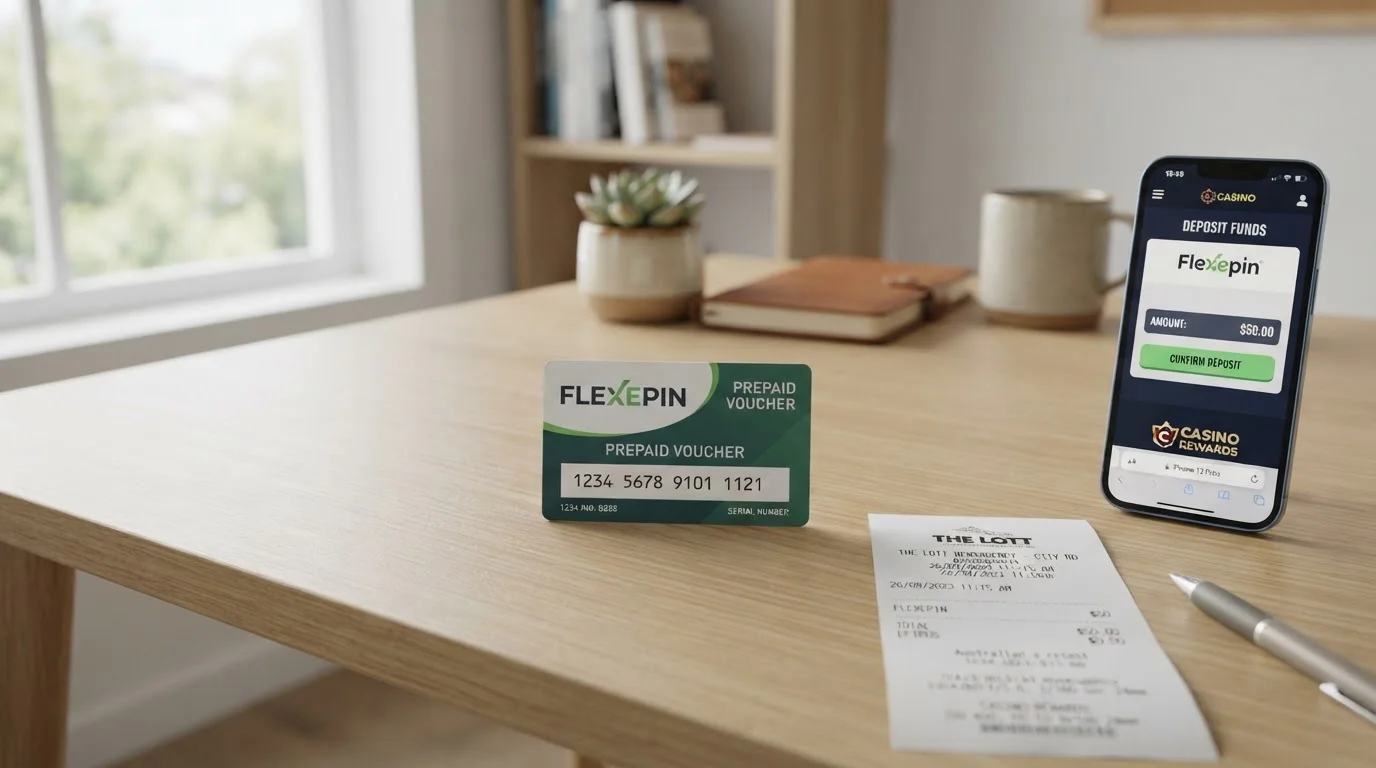
Prepaid vouchers—Neosurf, Paysafecard, CashtoCode, and Flexepin—let you deposit with cash. You buy a voucher at a retail location (7-Eleven, newsagent, petrol station), receive a PIN code, enter that code at the casino cashier, and funds appear instantly. No bank account required, no card details shared, no transaction on your bank statement.
All prepaid vouchers are deposit-only. You cannot withdraw to a voucher. That means pairing: deposit with Neosurf, withdraw with crypto or PayID or an e-wallet.
Neosurf
Neosurf is a 10-digit PIN voucher system available in Australia since 2015. You buy a Neosurf voucher at retail locations (7-Eleven, newsagents, petrol stations—over 1,000 outlets across Australia), select a denomination (A$10, A$20, A$50, A$100, A$250), pay cash, and receive a printed voucher with a 10-digit PIN.
At the casino, select Neosurf as your deposit method, enter the 10-digit code, specify the amount, and the balance appears instantly. You can combine multiple vouchers for larger deposits.
Fees: 0-3% at the retailer depending on the outlet. Casinos rarely add processing fees for Neosurf deposits.
Limits: A$10-250 per voucher. Combine multiple vouchers for deposits above A$250.
Acceptance: 70-80% of offshore casinos serving Australian players accept Neosurf deposits.
Paysafecard
Paysafecard is a 16-digit PIN voucher system, similar to Neosurf but with narrower Australian acceptance (50-60% of casinos versus 70-80% for Neosurf). Available at some newsagents and petrol stations, denominations typically A$20-100. Deposits are instant, deposit-only limitation applies, fees 0-3% at retailer.
Other Vouchers (CashtoCode, Flexepin)
CashtoCode: Barcode-based voucher system where you generate a barcode online, take it to a retail location, pay cash, and the casino credits your account. Less common in Australia—acceptance at casinos is limited.
Flexepin: PIN voucher available at some Australian retailers, denominations in AUD, instant deposits. Acceptance is narrow (20-30% of operators).
| Voucher | Denominations | Purchase Locations AU | Fees | Deposit-Only Limitation | Casino Acceptance |
|---|---|---|---|---|---|
| Neosurf | A$10-250 | 7-Eleven, newsagents, petrol stations (1,000+ outlets) | 0-3% at retailer | Yes | 70-80% |
| Paysafecard | A$20-100 | Newsagents, petrol stations | 0-3% at retailer | Yes | 50-60% |
| CashtoCode | Variable | Australia Post, newsagents | 0-3% at retailer | Yes | 20-30% |
| Flexepin | A$20-250 | Select retailers | 0-3% at retailer | Yes | 20-30% |
Can I deposit with Neosurf and withdraw with cryptocurrency?
Yes. Prepaid vouchers like Neosurf are deposit-only, so you must pair them with a withdrawal method—crypto, PayID, e-wallet, card, or bank transfer. Deposit with Neosurf (instant, cash-based, no bank details shared), play, then withdraw with cryptocurrency (fast, private, 2-5 hour settlement typical). Most casinos that accept Neosurf also accept crypto withdrawals; verify in the cashier before depositing. The combination gives you full privacy: cash-to-voucher (no bank statement at deposit) and crypto withdrawal (no bank statement at payout). The casino requires KYC for withdrawals over A$2,000-5,000 (proof of identity and address), but the payment rails themselves never touch your Australian bank account.
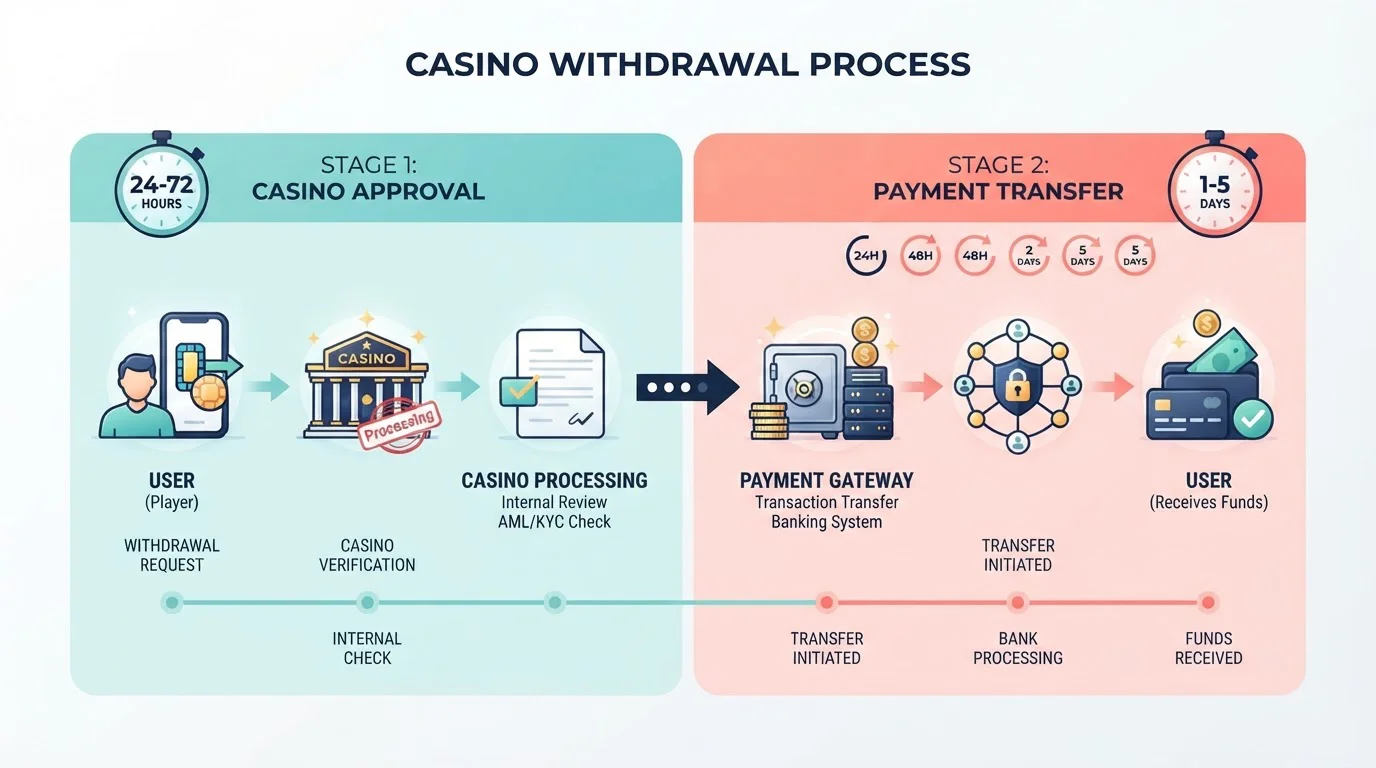
Withdrawal Speed Reality — From Casino Approval to Your Account
Advertised withdrawal times—”instant PayID,” “crypto withdrawals in minutes”—describe only the payment rail’s transfer time, not the full process. Every casino withdrawal has two stages: casino approval (the “pending” period) and payment method transfer time. Fast operators approve in 0-24 hours; slow operators take 24-72 hours. Then the payment method executes: PayID transfers in 1-4 hours, crypto in 2-5 hours, cards in 3-5 business days.
First withdrawals take 24-48 hours longer due to KYC verification. Casinos require proof of identity (driver’s license, passport) and proof of address (utility bill, bank statement dated within 90 days) before releasing funds. Submit KYC documents when you register to eliminate this delay.
The Two-Stage Withdrawal Process
Stage 1: Casino approval. You request a withdrawal and it enters “pending” status. Fast operators process approvals in minutes to hours. Average operators take 12-24 hours. Slow operators batch process once or twice daily, stretching approval to 24-72 hours.
Stage 2: Payment method transfer. Once approved, the casino initiates the transfer. PayID and Osko execute in 1-4 hours. Crypto settles in 2-5 hours. E-wallets clear in 0-4 hours. Cards take 3-5 business days.
The “instant withdrawal” claims refer only to Stage 2. Total time is Stage 1 + Stage 2.
First Withdrawal vs. Subsequent Withdrawals
Your first withdrawal at any casino takes 24-48 hours longer because of KYC verification. The casino reviews your proof of identity and proof of address before approving the payout. Once verified, the approval is permanent—your second and all future withdrawals skip KYC and process at the method’s normal speed.
How to eliminate first-withdrawal delay: Upload KYC documents immediately after registering, before making your first deposit. When you later request your first withdrawal, verification is already complete and the withdrawal processes at standard speed.
KYC Verification Timing
KYC verification is mandatory at all offshore casinos, though the trigger threshold varies. Small withdrawals (under A$2,000) sometimes skip verification; large withdrawals (over A$5,000) always require it.
What casinos require: proof of identity (driver’s license, passport, or national ID, current), and proof of address (utility bill, bank statement, or council rates notice dated within 90 days showing your name and residential address).
How long it takes: Fast operators verify in 1-6 hours. Average operators take 12-24 hours. Slow operators take 24-72 hours.
Fastest Withdrawal Operators Tested
Operator-by-operator tested withdrawal times (Stage 1 approval + Stage 2 transfer, first withdrawal after KYC complete):
| Operator | PayID Time | Crypto Time | E-Wallet Time | Card Time | KYC Delay First Withdrawal |
|---|---|---|---|---|---|
| SkyCrown | <15 min | <15 min (BTC, ETH, USDT) | Not tested | 3-5 days | 1-6 hours |
| Goldenbet | ~28 min | ~30 min (BTC, USDT) | Not tested | 3-5 days | 1-6 hours |
| Hell Spin | ~25 min | ~30 min (BTC, ETH) | 0-60 min (Skrill, Neteller) | 3-5 days | 6-12 hours |
| BitStarz | Not offered | 8-10 min (BTC) | Not tested | 3-5 days | 6-12 hours |
| Jack Casino | 1-2 hours | Instant (Wallet 2.0) | Not tested | 3-5 days | 12-24 hours |
| LuckyVibe | <1 hour | 1-3 hours (BTC, ETH) | 0-4 hours | 3-5 days | 12-24 hours |
| Lucky7Even | ~35 min | 1-2 hours (BTC) | Not tested | 3-5 days | 12-24 hours |
| National Casino | 1h 42min avg | 2-4 hours (BTC, ETH) | 2-4 hours | 3-5 days | 12-24 hours |
| Wild Tokyo | 1-3 hours | 2-4 hours (BTC, ETH) | Not tested | 3-5 days | 12-24 hours |
| SpinsUp | 1-4 hours | 2-5 hours (BTC, ETH) | 1-4 hours (Skrill, Neteller) | 3-5 days | 12-24 hours |
| Casinonic | <24 hours | <24 hours (BTC, ETH, LTC, USDT) | <24 hours | 3-5 days | 24-48 hours |
| Neospin | Described as fastest | Described as fastest | Not tested | 3-5 days | Not specified |
Speed leaders: SkyCrown for combined PayID and crypto (<15 minutes for both), BitStarz for Bitcoin (8-10 minutes), Jack Casino for instant crypto via Wallet 2.0 system. These are the operators to choose if withdrawal speed is your top priority.
Average operators: National Casino, Wild Tokyo, SpinsUp land in the 1-4 hour range for PayID and 2-5 hours for crypto—still same-day, but not instant. KYC delays are standard (12-24 hours).
Slow operators: Casinonic advertises “under 24 hours” which in practice means 12-24 hours for approval plus transfer time. Still faster than cards (3-5 days) but slower than leaders.
Why does my first withdrawal take longer than subsequent withdrawals?
Your first withdrawal at any casino takes 24-48 hours longer than subsequent ones because of KYC (Know Your Customer) verification. Casinos must verify your identity and address before releasing funds—regulatory requirement under anti-money-laundering laws, even for offshore operators. You submit proof of identity (driver’s license or passport) and proof of address (utility bill or bank statement dated within 90 days), the casino’s compliance team reviews it (1-24 hours depending on operator speed and queue size), and once approved the withdrawal processes at the payment method’s normal speed. Verification is permanent for that casino—after your first withdrawal clears, subsequent requests skip KYC and process immediately. To eliminate the first-withdrawal delay, upload KYC documents proactively when you register (before making your first deposit). When you later request a withdrawal, verification is already complete and the payout processes at standard speed (PayID 1-4 hours, crypto 2-5 hours, no 24-48 hour KYC delay added).
Minimum Deposits, Fees, and Limits Across Payment Methods
Minimum deposit thresholds vary by payment method and operator. Cards typically require A$10-20 minimums; crypto allows A$1-5 at some casinos; e-wallets land at A$10-20; vouchers enforce their denomination minimums (A$10-250). Maximum limits per transaction range from A$5,000 (common for PayID and cards) to A$50,000+ (crypto at high-roller-friendly operators). Fees appear in three places: network fees (Bitcoin $1-10, Ethereum $2-20, PayID zero), casino processing fees (0-2% depending on operator and method), and currency conversion spreads (0.5-2% above interbank rates when the casino’s base currency isn’t AUD).
The table below maps minimums, maximums, and fee structures across all methods:
| Method | Typical Minimum | Typical Maximum Per Transaction | Operators Allowing A$1-5 | Network/Rail Fees | Casino Processing Fees |
|---|---|---|---|---|---|
| PayID | A$10-20 | A$5,000-10,000 | None | A$0 | 0-1% (rare) |
| Bitcoin (BTC) | A$10-20 | A$10,000-50,000+ | BitStarz, Jack Casino, some crypto-focused | $1-10 | Usually absorbed on deposits, passed to player on withdrawals |
| Ethereum (ETH) | A$10-20 | A$10,000-50,000+ | BitStarz, some crypto-focused | $2-20 (gas fees) | Usually passed to player |
| Tether (USDT) | A$10-20 | A$10,000-50,000+ | Some crypto-focused | <$1 (TRC-20), $5-15 (ERC-20) | Usually passed to player |
| Litecoin (LTC) | A$10-20 | A$10,000-30,000 | Some crypto-focused | $0.10-1 | Usually passed to player |
| Visa/Mastercard | A$10-20 | A$5,000-10,000 | None | A$0 from network | 0-2% |
| Neteller | A$10-20 | A$5,000-20,000 | None | A$0 for AUD | 0-1% |
| Skrill | A$10-20 | A$5,000-20,000 | None | A$0 for AUD | 0-1% |
| ecoPayz (Payz) | A$10-20 | A$5,000-20,000 | None | A$0 for AUD | 0-1% |
| MiFinity | A$10-20 | A$5,000-20,000 | None | A$0 for AUD | 0-1% |
| Neosurf | A$10 (voucher min) | A$250 per voucher, combine multiple | None | A$0 from network | 0-3% at retailer |
| Paysafecard | A$20 (voucher min) | A$100 per voucher typical | None | A$0 from network | 0-3% at retailer |
| Apple Pay / Google Pay | A$10-20 | A$5,000-10,000 (inherits card) | None | A$0 (inherits card) | 0-2% (inherits card) |
| Osko | A$10-20 | A$5,000-10,000 | None | A$0 | 0-1% (rare) |
| BPAY | A$10-20 | A$5,000-10,000 | None | A$0 | Varies |
Method-specific minimums: Crypto-focused casinos like BitStarz allow deposits as low as A$1-5 for Bitcoin and other cryptocurrencies because blockchain transaction costs don’t scale with amount—sending A$5 or A$5,000 costs the same network fee. Traditional payment methods (cards, PayID, e-wallets) enforce A$10-20 minimums because lower amounts don’t justify the processing overhead. Prepaid vouchers have fixed denominations: Neosurf starts at A$10, Paysafecard at A$20.
Maximum variance: High rollers hit limits quickly with PayID and cards (A$5,000-10,000 per transaction, sometimes A$20,000-50,000 daily caps). Crypto offers higher ceilings—A$50,000+ per transaction at operators catering to high-stakes players. If you need to move large amounts, crypto or e-wallets (which sometimes allow A$20,000-50,000 per transaction) are the better choice.
Fee breakdown beyond “zero fees”: PayID network charges zero, but currency conversion spreads appear if the casino’s base currency is USD or EUR (typically 0.5-2% above interbank rates). Bitcoin’s $1-10 network fee is unavoidable—it goes to miners, not the casino—but some operators absorb it on deposits and pass it to players on withdrawals. Ethereum gas fees ($2-20) are always paid by someone; check whether the casino absorbs or passes the cost. E-wallets charge zero for same-currency transactions (AUD to AUD) but add 2.5-3.5% conversion spreads if you hold non-AUD balances. Cards may trigger international transaction fees (1-3%) if the casino’s merchant account is offshore.
What is the minimum deposit amount for Australian online casinos in 2026?
Minimum deposits at offshore casinos serving Australian players range from A$1 to A$20 depending on the payment method and operator. Crypto-focused casinos like BitStarz and Jack Casino allow deposits as low as A$1-5 for Bitcoin, Ethereum, Tether, and other cryptocurrencies. Standard operators enforce A$10-20 minimums for most payment methods: PayID, cards, e-wallets, and bank transfers typically start at A$10. Prepaid vouchers have fixed denominations: Neosurf starts at A$10, Paysafecard at A$20. The lowest practical minimum across all operators and methods is A$1 for crypto at specialist sites; the most common minimum is A$10 for fiat methods (PayID, cards, e-wallets) at average operators.

Legal Context — Australian Gambling Laws and the 2027 Payment Blocking Timeline
No Australian-licensed online casinos exist. The Interactive Gambling Act 2001 prohibits Australian companies from offering real-money casino games or pokies to Australian residents. ACMA (Australian Communications and Media Authority) does not issue licenses for online casinos—only sports betting and racing are licensed domestically. Every online casino serving Australian players operates under an offshore license: Curaçao (most common), Malta/MGA, Gibraltar, or Isle of Man. Playing at offshore sites is not illegal for individual Australians—the prohibition targets operators, not consumers—but these sites operate outside Australian consumer protection frameworks.
From 1 January 2027, the Interactive Gambling Amendment (Gambling Reform) Act 2026 grants Australian banks authority to block transactions to prohibited offshore gambling services. This shifts enforcement from domain blocking (ACMA blocking casino websites, which players bypass with VPNs) to financial disruption (banks refusing to process payments to offshore operators). The change affects payment method viability differently: methods that route through Australian banks (PayID, BPAY, Osko, direct bank transfers) face high blocking risk, while methods that use offshore processors (crypto, e-wallets, vouchers) face low risk.
Current state (pre-2027): Australian players can deposit and withdraw at offshore casinos using any method the operator accepts. Some banks already block gambling transactions under internal policies—particularly credit card gambling transactions—but enforcement is inconsistent. PayID, debit cards, and bank transfers mostly work; crypto and e-wallets always work because they bypass Australian banking rails.
Post-1 January 2027: Banks gain legal authority to identify and block transactions to prohibited operators. How aggressively they enforce this is unknown as of 2026—the legislation provides the power but doesn’t mandate blocking. Banks may block proactively, reactively (after ACMA identifies specific operators), or minimally (only when forced). Payment methods that require Australian bank participation are most vulnerable; methods that operate outside Australian banking infrastructure are least affected.
The table below maps each payment method’s vulnerability to bank blocking and suggests alternatives:
| Method | Bank Involvement Level | 2027 Blocking Risk | Alternative If Blocked | Why the Risk Rating |
|---|---|---|---|---|
| PayID | High (requires AU bank sender and receiver) | High | Crypto, e-wallets | Transfers between AU bank accounts; banks can identify recipient as gambling-related |
| Osko | High (requires AU bank sender and receiver) | High | Crypto, e-wallets | Same NPP infrastructure as PayID; identical risk profile |
| BPAY | High (domestic bill payment system) | High | Crypto, e-wallets, PayID (if available) | Explicitly Australian banking system; easy to identify and block |
| Bank transfer (standard) | High (AU bank to offshore account) | High | Crypto, e-wallets | Requires Australian bank; offshore recipient identifiable |
| Visa/Mastercard | Medium (AU card issuer, offshore merchant) | Medium | Crypto, e-wallets, PayID | Australian banks already block some card gambling transactions; 2027 may increase blocking, but card networks span jurisdictions |
| Apple Pay / Google Pay | Medium (tokenized card, inherits card risk) | Medium | Crypto, e-wallets | Tokenization may bypass some screening, but underlying card is AU-issued |
| Neteller | Low (offshore e-wallet processor) | Low | Crypto, other e-wallets | No Australian bank involvement in casino transaction; bank sees “Neteller,” not casino |
| Skrill | Low (offshore e-wallet processor) | Low | Crypto, other e-wallets | Same as Neteller; privacy layer protects from blocking |
| ecoPayz (Payz) | Low (offshore e-wallet processor) | Low | Crypto, other e-wallets | Offshore processor; Australian banks don’t see casino transaction |
| MiFinity | Low (offshore e-wallet processor) | Low | Crypto, other e-wallets | Offshore processor; privacy layer intact |
| Bitcoin (BTC) | None (decentralized, no bank involvement) | Low | Other cryptos, e-wallets | No Australian banking system involvement; immune to bank blocking |
| Ethereum (ETH) | None (decentralized, no bank involvement) | Low | Other cryptos, e-wallets | Same as Bitcoin; operates outside banking rails |
| Tether (USDT) | None (crypto, no bank involvement) | Low | Other cryptos, e-wallets | Blockchain-based; no Australian bank can block on-chain transfers |
| Litecoin (LTC) | None (decentralized, no bank involvement) | Low | Other cryptos, e-wallets | Same as Bitcoin; immune to bank blocking |
| Neosurf | None (cash voucher, purchased retail) | Low | Paysafecard, crypto | Cash purchase; no banking involvement |
| Paysafecard | None (cash voucher, purchased retail) | Low | Neosurf, crypto | Cash purchase; no banking involvement |
High-risk methods (PayID, BPAY, Osko, bank transfers): Require Australian financial institutions to participate in the transaction. Banks can identify the recipient as an offshore casino and refuse to process. If you rely on PayID today, have a backup plan (crypto or e-wallet account set up) before 1 January 2027.
Medium-risk methods (cards, mobile payments): Australian banks issue your card and can decline gambling transactions, but card networks (Visa, Mastercard) operate globally and some transactions may slip through geographic or merchant-code screening. Bank blocking of card gambling transactions already happens sporadically in 2026; 2027 may increase enforcement but won’t achieve 100% blocking.
Low-risk methods (crypto, e-wallets, vouchers): Operate outside Australian banking infrastructure. Your bank may see a transfer to Binance (crypto exchange) or Neteller (e-wallet), but it doesn’t see the subsequent casino transaction. Casinos receive crypto or e-wallet payments directly, bypassing Australian banks entirely. Vouchers are purchased with cash, eliminating banking involvement. These methods are structurally resistant to bank blocking.
What happens on 1 January 2027: The law takes effect, but enforcement ramps gradually. ACMA must identify prohibited operators and communicate them to banks; banks must implement blocking systems. Expect inconsistent enforcement in early 2027—some transactions blocked, others passing through—followed by tighter controls as systems mature. Players using high-risk methods should migrate to low-risk alternatives before enforcement solidifies.
What happens to my payment methods after the January 2027 bank blocking law takes effect?
From 1 January 2027, Australian banks gain authority to block transactions to prohibited offshore gambling operators under the Interactive Gambling Amendment 2026. Payment methods that route through Australian banks—PayID, BPAY, Osko, and direct bank transfers—face high blocking risk because banks can identify the recipient as a gambling service and refuse to process. Crypto (Bitcoin, Ethereum, Tether, Litecoin) and e-wallets (Neteller, Skrill, ecoPayz, MiFinity) face low risk because they operate outside Australian banking infrastructure—your bank sees a transfer to a crypto exchange or e-wallet, not the casino, and the subsequent casino transaction happens offshore. Cards sit in the middle: some Australian banks already block gambling card transactions under internal policies; 2027 may increase blocking but won’t achieve total enforcement because card networks span jurisdictions. If you currently use PayID or BPAY, set up a crypto wallet or e-wallet account before 2027 as a backup. If you use cards, test whether transactions still process in early 2027 and switch to crypto or e-wallets if blocking begins.
How to Choose the Right Payment Method for Your Priorities
Fourteen payment methods serve Australian casino players; picking the right one depends on whether you prioritize speed, privacy, low fees, or convenience. No single method wins on all dimensions—PayID is fast and convenient but vulnerable to 2027 bank blocking; crypto is fastest and immune to blocking but involves volatility risk; e-wallets offer privacy and speed but exclude you from bonuses; cards are familiar but slow. The decision framework below maps your top priority to the best method.
Priority: Fastest withdrawal. Choose crypto (Bitcoin, Ethereum, Tether, Litecoin) or PayID at fast operators. Crypto withdrawals tested at 8-10 minutes (Bitcoin at BitStarz), under 15 minutes (Bitcoin and Ethereum at SkyCrown), sub-1 hour (TRC-20 Tether at fast operators), 2-5 hours average across most operators. PayID withdrawals tested at under 15 minutes (SkyCrown, Goldenbet, Hell Spin), 1-4 hours at average operators. E-wallets (Neteller, Skrill) clear in 0-4 hours, faster than PayID at some casinos. Cards take 3-5 business days—not competitive for speed. If you want same-day payouts, avoid cards and bank transfers.
Priority: Privacy and anonymity. Choose crypto (highest privacy), e-wallets (Neteller, Skrill, ecoPayz, MiFinity), or prepaid vouchers (Neosurf, Paysafecard). Crypto deposits and withdrawals bypass your bank statement entirely—your bank sees a transfer to Binance or Coinbase, not a casino. E-wallets create a privacy layer: your bank sees Neteller or Skrill, the casino sees an e-wallet transaction, neither sees the other. Vouchers are cash-based: buy at a retailer, deposit the PIN, no banking involvement. PayID, cards, BPAY, and bank transfers all appear on Australian bank statements with recipient names that often identify gambling. Crypto offers the strongest privacy but requires KYC at the casino level for large withdrawals (typically over A$2,000-5,000); e-wallets and vouchers also require casino KYC.
Priority: Lowest fees. Choose PayID or TRC-20 Tether. PayID charges zero network fees; some casinos add 0-1% processing fees, but most charge nothing. TRC-20 Tether costs under $1 in network fees per transaction, the cheapest crypto option. Litecoin charges $0.10-1, also low. Bitcoin costs $1-10, Ethereum $2-20 (gas fees swing with network congestion). E-wallets charge 0-1% transaction fees but add 2.5-3.5% currency conversion spreads if you hold non-AUD balances. Cards add 0-2% processing fees plus potential international transaction fees (1-3%) and currency conversion spreads. Vouchers charge 0-3% at the retailer. Avoid Ethereum during network congestion (gas fees hit $20); avoid e-wallet currency conversions.
Priority: Convenience and ease of use. Choose PayID (if Australian bank account holder) or cards (Visa, Mastercard). PayID links to your mobile number; deposits take 6-30 seconds with no setup beyond registering your PayID in your banking app. Cards require no setup—everyone has one—and deposits are instant by entering card details. Both are familiar, low-friction methods. The tradeoff: PayID faces 2027 blocking risk, and cards have slow withdrawals (3-5 days). If convenience is top priority but you want to avoid 2027 risk, mobile payments (Apple Pay, Google Pay) offer one-tap deposits but inherit card withdrawal timing.
Priority: Future-proofing against 2027 bank blocking. Choose crypto (Bitcoin, Ethereum, Tether, Litecoin) or e-wallets (Neteller, Skrill, ecoPayz, MiFinity). Both operate outside Australian banking infrastructure and are structurally resistant to bank blocking. Crypto is immune—decentralized blockchains don’t route through Australian banks. E-wallets create a layer: your bank transfers to the e-wallet, the e-wallet transfers to the casino, and banks can’t block the second leg. PayID, BPAY, Osko, and bank transfers are high-risk after 1 January 2027. Cards are medium-risk (some blocking likely, not total). Set up a crypto wallet or e-wallet account now if you’re currently using high-risk methods.
Priority: Keeping bonus eligibility. Choose PayID, cards, crypto, or bank transfers. These methods usually qualify for casino welcome bonuses. E-wallets (Neteller, Skrill) are excluded from 60-70% of bonuses; ecoPayz and MiFinity are excluded less often but still appear in some exclusion lists. Always read the bonus terms before depositing—phrases like “e-wallets excluded” or “Neteller and Skrill deposits do not qualify” mean you forfeit the bonus by using those methods. If the welcome offer matters and you want fast withdrawals, pair a PayID or crypto deposit (bonus-eligible) with a crypto withdrawal (fast payout).
Priority: Low minimum deposits. Choose crypto at specialist casinos (BitStarz, Jack Casino allow A$1-5 deposits). Standard operators enforce A$10-20 minimums for all methods. Prepaid vouchers have fixed denominations (Neosurf A$10 minimum, Paysafecard A$20). If you want to test a casino with minimal risk, crypto at a low-minimum operator is the cheapest entry point.
Decision tree summary: speed points to crypto (BitStarz, SkyCrown) or PayID at the fast operators; privacy points to crypto, e-wallets or vouchers; low fees point to PayID or TRC-20 Tether; convenience points to PayID or cards; 2027-proofing points to crypto or e-wallets; bonus eligibility points to PayID, cards or crypto (avoid e-wallets); low minimums point to crypto at specialist casinos.
Payment Method Bonuses and Restrictions
Casino welcome bonuses—matched deposit offers, free spins packages, no-wagering cash—come with payment method restrictions. E-wallets (Neteller, Skrill) are excluded from 60-70% of bonuses; ecoPayz and MiFinity are excluded less often. Cards, PayID, crypto, and bank transfers usually qualify. The exclusion appears in the bonus terms and conditions, often buried under “General Terms” or “Bonus Policy” rather than highlighted on the promotion page. Depositing with an excluded method forfeits the bonus even if you didn’t notice the restriction.
Why e-wallets are excluded: E-wallet bonus abuse is a known pattern in the gambling industry. A player deposits with Neteller, claims a bonus, plays through the wagering requirement, withdraws to a different Neteller account, and repeats at multiple casinos. E-wallets enable this because you can hold multiple accounts and move money between them easily. Casinos combat abuse by excluding e-wallets entirely. The policy punishes legitimate players (most e-wallet users aren’t abusing bonuses), but operators accept that tradeoff to block exploitation.
Method-by-method bonus eligibility (general pattern, always verify in the specific casino’s terms):
- PayID: Usually eligible
- Cards (Visa, Mastercard, Amex): Usually eligible
- Crypto (Bitcoin, Ethereum, Tether, Litecoin): Usually eligible
- Bank transfers: Usually eligible
- Neteller: Excluded 60-70% of the time
- Skrill: Excluded 60-70% of the time
- ecoPayz (Payz): Excluded 30-40% of the time
- MiFinity: Excluded 20-30% of the time
- Prepaid vouchers (Neosurf, Paysafecard): Usually eligible
- Mobile payments (Apple Pay, Google Pay): Usually eligible (inherits card eligibility)
Deposit method matching requirements: Some casinos require you to withdraw using the same method you deposited with, or at least the same category (fiat to fiat, crypto to crypto). This prevents deposit-bonus-withdraw-via-different-rail abuse. If you deposit with PayID, the casino may mandate PayID withdrawal; if you deposit with Neosurf (deposit-only voucher), the casino lets you withdraw via crypto or another method. Matching requirements vary by operator—verify in the withdrawal terms before depositing.
How to check before depositing: Open the bonus terms page (usually linked from the promotion banner or footer). Search for “excluded,” “e-wallet,” “Neteller,” “Skrill,” “payment method.” If the terms say “deposits via e-wallets do not qualify” or list specific methods, those deposits forfeit the bonus. If unsure, contact support before depositing—ask “If I deposit with [method], do I qualify for the [bonus name]?” and save the transcript. Support confirmation protects you if a dispute arises later.
Casino Deposit Methods Australia 2026 — Full Comparison
Content created by the «Aussie Cashier» team